



How LIMA Leverages AI to Reshape the Underlying Computing Power for Quantitative Hedging and Private Wealth Management
For a long time, the asset management industry was viewed as the exclusive domain of experience and intuition. However, driven by the exponential advancements in Generative AI (GenAI), Large Language Models (LLMs), and Deep Reinforcement Learning in recent years, the financial sector has officially entered its own “Moore’s Law” moment.
At LIMA Global, we do not regard AI merely as an office tool to assist traders; instead, we position it as the “central nervous system” of our entire asset management architecture. The traditional hedge fund model—relying on teams of analysts to pore over financial reports and piece together data—is now obsolete. Algorithms are comprehensively reshaping the fundamental logic of the industry—from the generation of excess returns (Alpha) to the construction of market Beta—across unprecedented dimensions.

I. The Generational Gap Between Traditional Quantitative Investing and LIMA AI-Driven Quantitative Investing
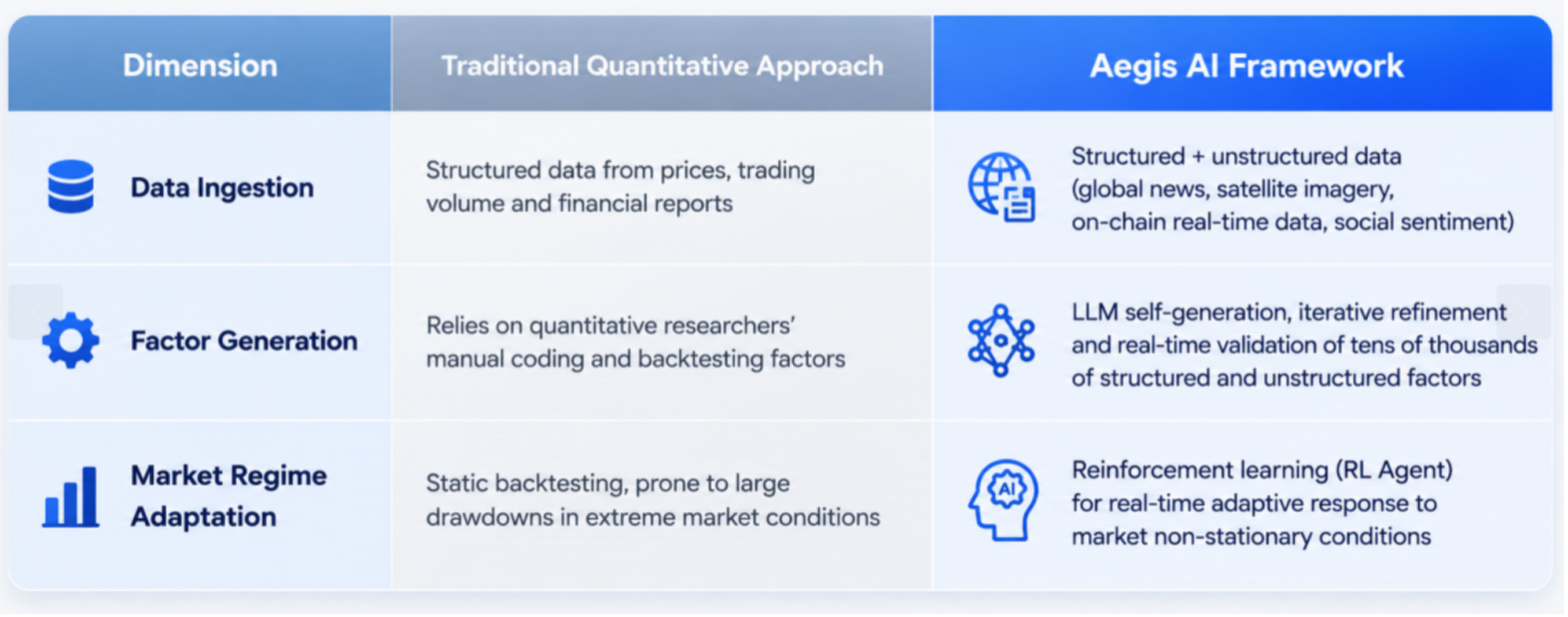
Traditional factor investing relies on linear statistical models based on human-conceived hypotheses (such as the Fama-French multi-factor model). However, in the face of extremely complex global macro environments and the intricate interdependencies of multi-asset classes, traditional quantitative methods often suffer from severe “overfitting” and a lack of resilience against “Black Swan” events.
A new generation of quantitative systems—powered by deep reinforcement learning and multimodal AI—has achieved breakthroughs across three key dimensions:
II. AI’s Deep Empowerment in Private Wealth Management: Hyper-Personalization
Traditional private wealth management faces an insurmountable “impossible trinity”: high-quality customized service, low management costs, and broad client coverage. Typically, only Ultra-High-Net-Worth (UHNW) clients—with assets in the tens of millions of dollars—could access tailored strategies from dedicated asset management teams.
The widespread adoption of AI has fundamentally transformed this landscape:
- Dynamic, Highly Personalized Portfolio Construction: AI algorithms can generate and optimize bespoke investment portfolios in seconds, factoring in a client’s tax status, cash flow requirements, risk appetite, and even ESG or personal value preferences.
- Real-Time Tax-Loss Harvesting: Navigating complex Colorado and federal tax systems, LIMA’s AI monitors holdings 24/7. It automatically swaps similar assets within seconds—without altering the portfolio’s risk profile—to help clients maximize tax deduction benefits.
- Natural Language-Based Risk Attribution: Clients no longer need to wade through lengthy, obscure monthly PDF reports. Instead, they can simply ask questions in natural language—such as, “How would my crypto and RWA portfolio be affected if the Federal Reserve cuts interest rates by 50 basis points?”—and the system provides millisecond-level analysis and actionable recommendations based on deep simulations.
III. LIMA Global’s Technological Moat: The LIMA-Brain Architecture
Our technical team independently developed the LIMA-Brain asset management “Large Model” architecture at our Denver headquarters. This architecture comprises three core modules:
- Data Perception Layer: Continuously (24/7) cleanses data from global financial markets, geopolitical and economic developments, and public blockchain mempools, identifying market sentiment inflection points in seconds.
- Strategy Game Engine: Utilizes Multi-Agent Generative Adversarial Networks (Multi-Agent GANs) to simulate asset price evolution under various extreme macroeconomic scenarios, ensuring the strategy’s resilience and robustness.
- Smart Execution Engine: By combining dark pools with algorithmic routing across on-chain decentralized exchanges (DEXs), this engine breaks down large orders into micro-streamed trades, achieving zero market impact.
AI is not intended to replace human professionals in finance; rather, it frees human investment managers from inefficient data analysis, allowing them to focus on high-level strategic decisions and client empathy. At LIMA Global, human insight and machine computing power have combined to create a powerful flywheel effect.